tl;dr: analyzed billboard chart performance of 65 grammy best new artist winners across 68 years. 67.9% of artists had a top 10 single after the grammy win (up from 56.6% before). the curse doesn’t exist, it’s just confirmation bias and recycled journalism.
since 2020, i’ve run an annual grammy predictions survey with my friends. this year, 30 people participated - we vote on who we think will win each major category, and i give a gift card to whoever gets the most right. it’s become this tradition that shows who’s in tune with the pulse of pop culture and who’s just guessing based on vibes.
every year, the best new artist category sparks the same debate: is winning this award actually a good thing? the “best new artist curse” is music industry folklore - the idea that winning dooms your career. people point to fun. (broke up shortly after), macklemore & ryan lewis (disappeared after their viral moment), and various one-album wonders as proof.
if you google “grammy best new artist curse,” you’ll find vanity fair articles, variety explainers, rolling stone retrospectives - all recycling the same narrative. every february, publications dust off the same 4-5 examples from the ‘70s-’90s: starland vocal band, milli vanilli, arrested development.
the story is everywhere. everyone “knows” it’s real.
except… what if we actually tested it with data?
i wanted to know: is this actually true, or just confirmation bias?
so i spent 350 hours collecting data on 65 best new artist winners across 68 years (1958-2026) to test it. this is my first real dive into music data analysis, and it became both a personal curiosity project and the inaugural post in what we’re hoping becomes a series exploring music through data at moonpath.
what i found
the best new artist curse doesn’t exist.
at least not in the way people think. looking at peak chart performance - the best position artists achieved before versus after their grammy win - there’s no statistical evidence of a curse.
the data:
- 67.9% of winners hit top 10 on hot 100 after their grammy (up from 56.6% before)
- 61.0% hit top 10 on billboard 200 after their grammy (up from 42.4% before)
- more winners hit #1 albums after grammy (8 artists) than before (4 artists)
- no statistically significant decline in peak positions for singles (p=0.35) or albums (p=0.05)
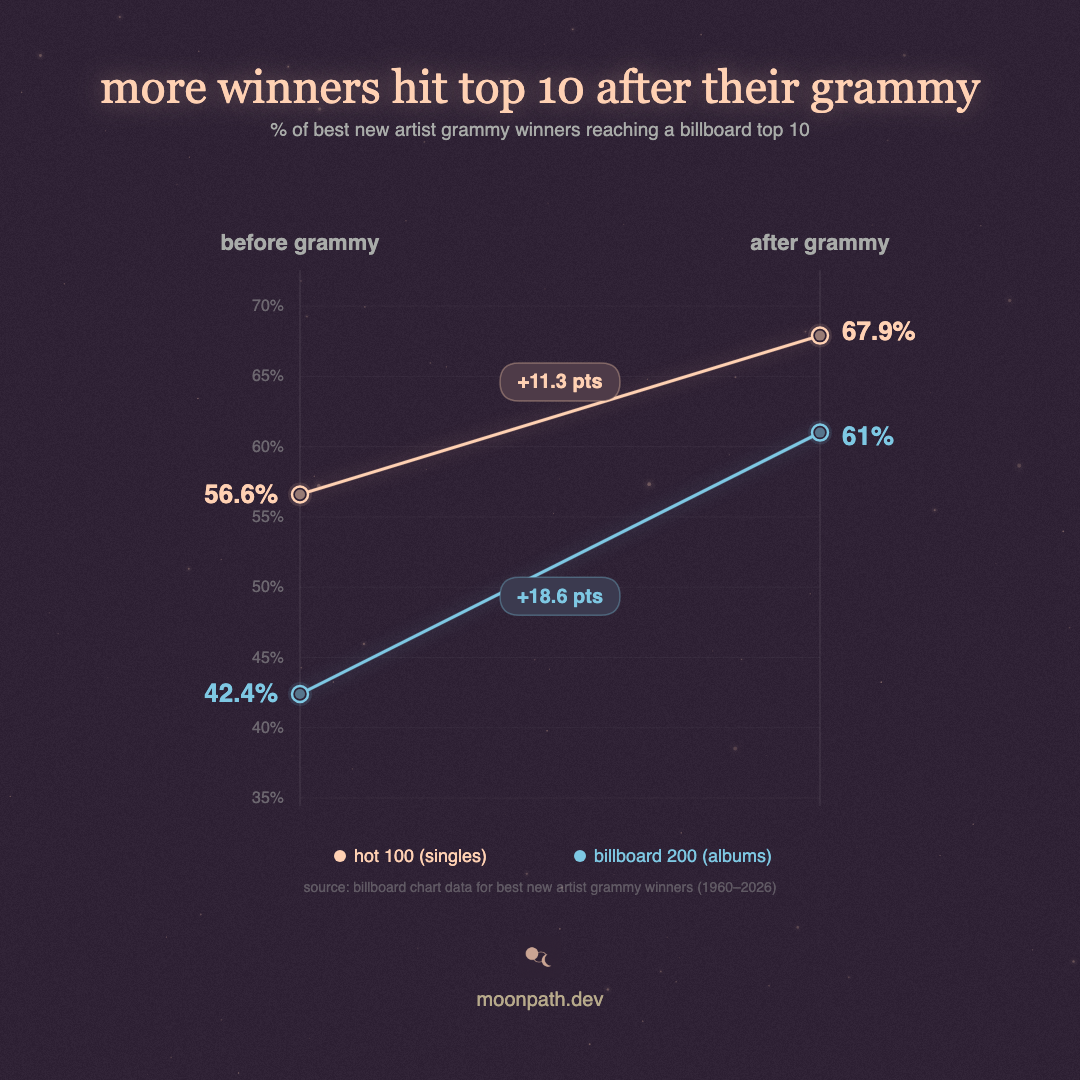
most winners maintain or improve their peak chart performance after winning. the curse is folklore, not fact.
what i’m testing (and what i’m not)
what this analysis measures: chart performance - whether winners could still release hit music after their grammy.
what it doesn’t measure:
- band breakups
- personal tragedies
- career longevity
- critical acclaim
- cultural impact
some articles cite the beatles as “cursed” because they broke up in 1970, five years after winning. but their chart performance never declined - they maintained #1 hits until they disbanded.
the “curse” narrative mixes together different kinds of outcomes:
- chart decline (what i’m measuring)
- band breakups (fun., the beatles)
- scandals (milli vanilli)
- personal struggles (lauryn hill, amy winehouse)
- one-hit wonders (starland vocal band)
i’m testing one specific claim: does winning best new artist hurt your ability to chart hit music?
the answer: no. 67.9% of winners hit top 10 after their grammy, up from 56.6% before.
bands break up for lots of reasons. artists face personal struggles. some have short careers regardless of awards, but the data shows winning best new artist doesn’t doom your chart performance.
the success stories
adele
adele won best new artist in 2009 for her album “19.”
chart performance:
- peak before grammy: #41 (billboard 200)
- peak after grammy: #1 (billboard 200)
her best albums - “21” and “25” - both hit #1 and came after her grammy win.
the beatles
the beatles won in 1965 at the height of beatlemania. they maintained #1 performance on both singles and albums after winning. yes, they broke up in 1970 - but their chart performance never declined.
maroon 5
maroon 5 won in 2005. before their grammy, they had 3 charting singles with a peak of #6. after? 18 charting singles including two that hit #1 (“moves like jagger” and “one more night”).
billie eilish
billie showed small declines in peak position (singles: #3 before → #6 after, albums: #3 → #4), but she’s still producing top 5 albums and top 10 singles. “birds of a feather” hit #6 in 2024 and was still charting in early 2025.
whether looking at singles or albums, many winners either maintained or improved their peak performance after the grammy.
why do people believe the curse?
publications have been recycling the same story for 50 years
every grammy season, music publications publish some version of “is the best new artist curse real?” or “is the curse finally over?”
they cite the same artists:
- starland vocal band (1977) - broke up, band member called it “the kiss of death”
- milli vanilli (1990) - scandal, award rescinded
- arrested development (1993) - one album wonder
- a taste of honey (1979) - faded after one hit
these 4-5 commercial downfalls from the ‘70s-’90s get mentioned in every article. meanwhile, 40+ sustained careers get ignored.
the narrative survives because it’s a better story than “most winners do fine.”
we remember the dramatic failures
fun. broke up shortly after winning in 2013. their singles peak went from #1 (“we are young”) to #14 post-grammy. the band dissolved - but jack antonoff, their guitarist, went on to become one of the most dominant producers in music. he’s won producer of the year multiple times and produced grammy-winning work for taylor swift, kendrick lamar, and countless others. the band failed, but its members didn’t.
macklemore & ryan lewis had a massive cultural moment with “thrift shop” (#1 in 2013), won best new artist in 2014, then seemingly disappeared. their best post-grammy single only hit #16. they were a viral phenomenon - the kind of lightning-in-a-bottle moment that’s nearly impossible to replicate.
these are natural career arcs. some artists peak early, some sustain, some reinvent. the grammy didn’t determine which path they took.
the psychology of it
we’re wired to remember the dramatic failures - the scandal, the one-hit wonder, the band that broke up. the consistent successes fade into background noise, even when they outnumber the failures.
about 47% of winners on hot 100 and 42% on billboard 200 had worse peak positions after their grammy. that means 53% maintained or improved singles peaks, and 58% maintained or improved album peaks.
more winners succeed than fail. the curse narrative focuses on the minority.
the “curse is over” narrative misses the point
recent articles claim the curse has “finally ended” because billie eilish, olivia rodrigo, and megan thee stallion succeeded after winning.
but the curse didn’t “end” recently. it never existed.
winners from every era succeeded:
- adele won in 2009 (#41 → #1)
- mariah carey won in 1991 (massive success, 19 #1 hits total)
- the beatles won in 1965 (maintained #1 performance)
- maroon 5 won in 2005 (3 songs → 18 songs, including two #1 hits)
recent winners didn’t “break” the curse - they just made us pay attention to what the data showed all along.
how i did this
what i analyzed:
- 65 best new artist winners (1960-2026)
- 2,526 billboard chart entries
- both hot 100 (singles) and billboard 200 (albums)
- peak chart positions before vs after grammy win
- quarterly sampling: 4 dates per year (jan, apr, jul, oct)
- time window: 5 years before win → 10 years after
why peak positions?
i wanted to know if winners could still release hit music - not whether they sustained constant visibility. a #1 album is a #1 album, whether it happens the year of the grammy or five years later.
missing artist:
samara joy (2023 winner) has never charted on hot 100 or billboard 200. she’s a jazz artist - proof you can win best new artist through critical acclaim without mainstream commercial chart presence.
fun fact:
olivia dean, the 2026 best new artist winner, has the middle name lauryn - named after lauryn hill, who won best new artist in 1999. dean was born in 1998, the year hill’s “the miseducation of lauryn hill” dominated. a full-circle grammy moment.
what i learned
this was my first web scraping project. i woke up every morning excited to check the progress - watching the dataset grow from 10 artists to 65 felt like watching a hypothesis come to life.
the surprising part: i genuinely expected to find evidence of a curse. the concept is so debated that i assumed there had to be something to it. finding that winners actually hit top 10 more after their grammy was unexpected.
this project also taught me how narratives spread without fact-checking. publications cite each other’s articles, which cite older articles, creating a self-referential loop. the “curse” became “true” through repetition, not evidence.
i found myself falling for it too - i expected to find a curse because i’d read so many articles about it. confirmation bias works on everyone, including people actively trying to test for it.
limitations
quarterly sampling:
i sampled 4 dates per year rather than every week. this captures major hits but misses songs that charted briefly at lower positions.
no streaming data: the spotify api has been down during this project. streaming data would provide modern commercial success metrics, especially for post-2010 artists.
pre-streaming era bias:
most of the dataset (55 of 65 artists) is from 1960-2010. chart dynamics changed significantly with streaming.
no control group:
i only analyzed winners. comparing to best new artist nominees who lost would show whether winning causes anything or if breakthrough artists in general face similar trajectories.
peak positions don’t show everything:
an artist who hits #1 once then disappears looks the same as an artist who hits #1 and sustains a long career. peaks measure ceiling, not consistency or longevity.
what this means
after analyzing 68 years of grammy winners and 2,526 billboard chart entries, i found no statistical evidence that winning best new artist hurts chart performance.
music publications have recycled the curse narrative for 50 years, but they mix together different outcomes:
- chart decline (adele went up)
- band breakups (the beatles broke up but maintained #1 performance)
- scandals (milli vanilli’s award was rescinded)
- personal struggles (amy winehouse, lauryn hill)
these are different phenomena. the data addresses one specific claim: does winning hurt your ability to release hit music?
the data:
- 67.9% hit top 10 after winning (up from 56.6%)
- 2x more artists hit #1 albums after winning
- 53% maintained or improved singles peaks
what the curse ISN’T:
- a guarantee of longevity (some careers are naturally short)
- protection against band breakups (creative differences happen)
- immunity from personal struggles (unrelated to the award)
the gap between data and narrative is significant. publications cite the beatles as “cursed” because they broke up - but they never stopped charting #1 hits. they cite fun. because the band dissolved - but jack antonoff became producer of the year. they cite amy winehouse who died tragically - but her chart performance was stellar.
the best new artist award doesn’t doom your chart performance. chappell roan won in 2025. based on 68 years of data, her ability to release hit music is just fine.
what’s next: testing “better to lose than win”
articles love pointing out that taylor swift, kacey musgraves, and paramore all lost best new artist and went on to massive careers.
the implication: maybe it’s better to lose than win.
phase 2 would test this directly by comparing winners vs. nominees who lost:
matchups:
- amy winehouse (won 2008) vs. taylor swift (lost)
- macklemore & ryan lewis (won 2014) vs. kendrick lamar (lost)
- fun. (won 2013) vs. frank ocean (lost)
this would answer: does winning cause anything, or do breakthrough artists just follow natural career arcs regardless of who takes home the trophy?
estimated effort: 20-30 hours scraping 30-50 additional artists.
this would turn a good analysis into a definitive one that directly challenges the “better to lose” narrative.
this is the first post in our music data series
at moonpath, we’re interested in exploring the stories hidden in listening patterns, chart positions, and the way music marks time in our lives.
if you’re curious about your own music data, check out seasons of your life - upload your streaming data and see which songs defined every era of your life. the first 100 users get free full access.
or share an anonymous music memory at resonance - our platform for the songs that meant something to you.
follow along on instagram for regular updates.
questions? thoughts? disagree with my findings? reach out at hello@moonpath.dev or find me on linkedin
this analysis represents my personal research and is not professional music industry analysis. i’m an analyst and program manager who loves music data - not a music industry expert.
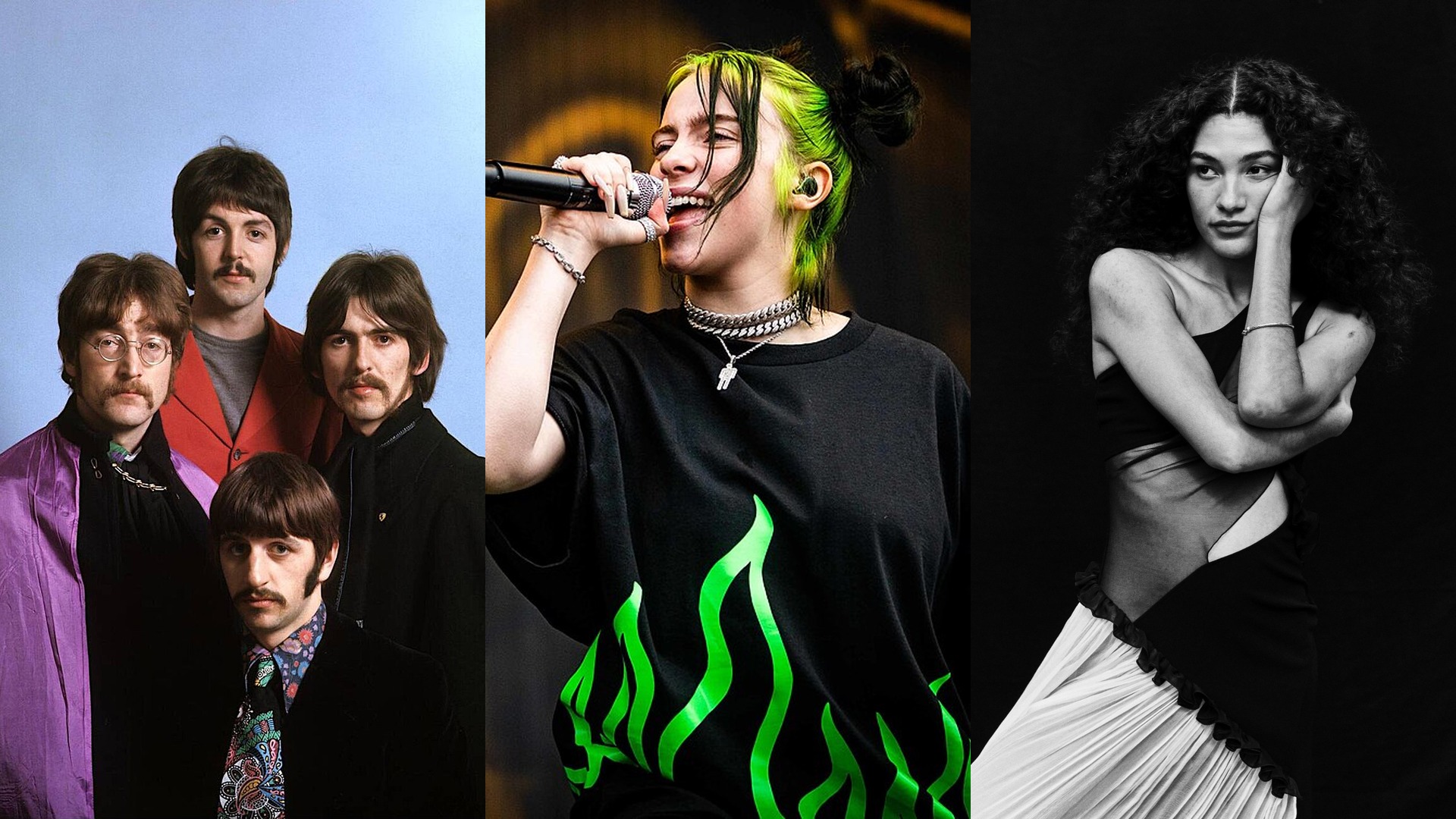
cover photo credits: the beatles, 1967, henry grossman / capitol records. billie eilish at pukkelpop, 2019, lars crommelinck (CC BY-SA 4.0). olivia dean, jack davison / chuff media.